Transitioning to Skills in Demand Visa (SID)-Subclass 482
As of 2025, Australia’s temporary skilled migration landscape has transformed. The old "Temporary Skill Shortage" (TSS) era has evolved into the Subclass 482 Skills in Demand (SID) visa. This new framework is designed to be more flexible, providing clearer pathways for skilled workers and more certainty for employers.
But with three distinct "streams" now available, the first question every applicant and employer asks is: Which path is mine?
The Three-Stage Journey
Before diving into the streams, it is important to remember that the SID visa is a three-stage process. You cannot simply "apply" for the visa; you must be part of a coordinated effort with an Australian employer.
Sponsorship: The employer is approved to hire from overseas.
Nomination: The employer identifies a specific role and link it to you.
Visa Application: You apply to stay and work in that role.
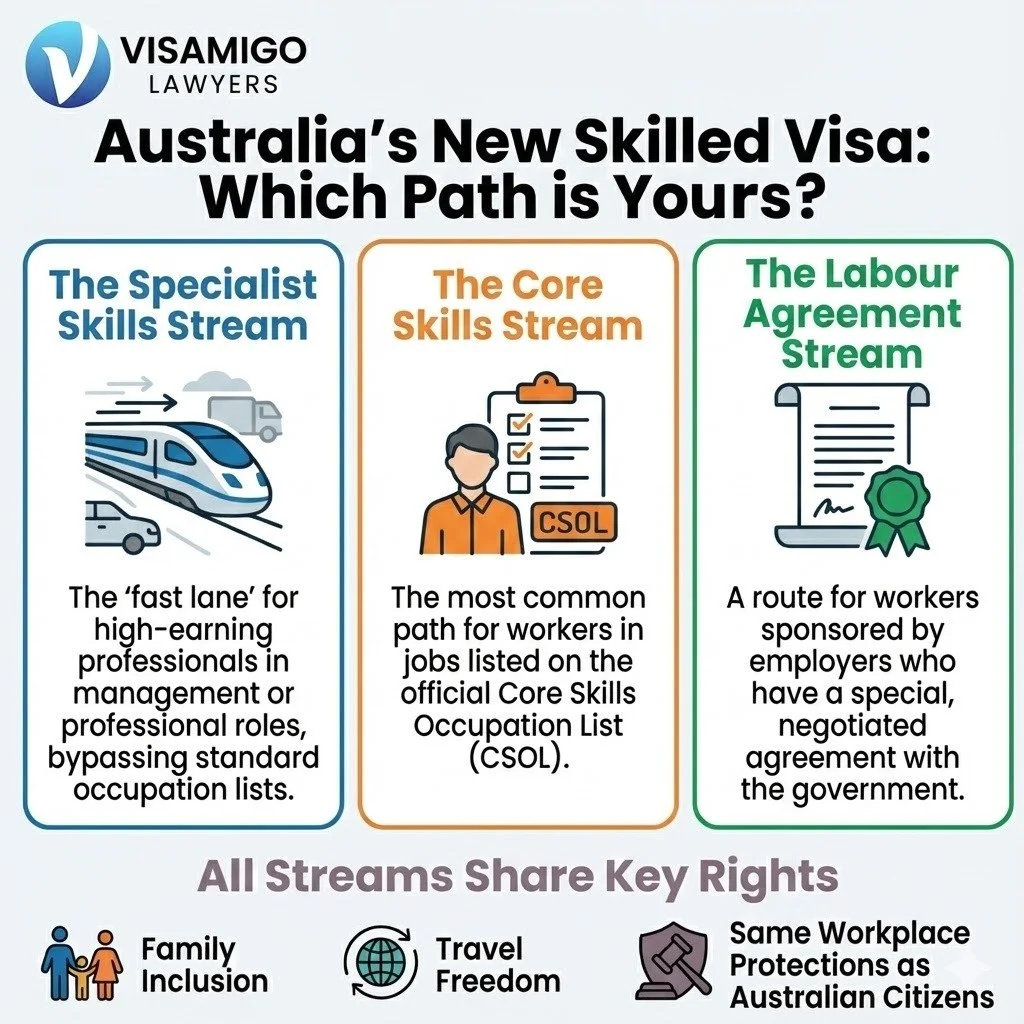
1. The Specialist Skills Stream
This stream is the "fast lane" for high-end talent. It is designed for highly skilled professionals in almost any industry, provided they are among the top earners in their field.
Who it’s for: Professionals in ANZSCO Major Groups 1 (Managers), 2 (Professionals), 4, 5, or 6.
The Income Bar: You must earn at least the Specialist Skills Income Threshold (which is significantly higher than the standard skilled salary).
The Benefit: This stream bypasses some of the rigid occupation lists required by other paths, focusing instead on high-level expertise and economic contribution.
2. The Core Skills Stream
This is the "mainstream" path and will likely be the most common route for the majority of skilled workers entering Australia in 2025.
Who it’s for: Workers whose occupations are listed on the Core Skills Occupation List (CSOL). This list is updated regularly to reflect the actual needs of the Australian economy.
The Income Bar: You must earn at least the Core Skills Income Threshold.
The Benefit: It provides a predictable pathway for essential roles in healthcare, trades, technology, and education that don't necessarily hit the "Specialist" salary heights but are critical to the country.
3. The Labour Agreement Stream
Sometimes, the standard lists and salary rules don't fit a specific industry's unique needs. This is where the Labour Agreement stream comes in.
Who it’s for: Employers who have a specific, negotiated agreement with the Australian Government. This is common in regional areas or niche industries (like the meat industry or on-hire firms).
The Benefit: These agreements can include "concessions" or variations on English language requirements, salary, or age, provided the employer can prove they genuinely cannot find an Australian for the job.
Shared Benefits Across All Streams
Regardless of which stream you enter under, the SID visa offers a consistent set of rights:
Family Inclusion: You can bring eligible partners and children, who have full work and study rights.
Travel Freedom: No limit on how many times you can enter or leave Australia while the visa is valid.
Worker Protection: You are entitled to the same workplace rights as an Australian citizen, including parity in pay with local workers.
📩 Contact us today!
📞 +61 439184999 📧 ask@visamigo.com.au
🌐 www.visamigo.com.au
Disclaimer: Important notice for all our social media followers and website readers. Content shared here by Visamigo Lawyers and its affiliates is not to be considered as immigration or legal advice. It is intended for informational purposes only and should not be used as a substitute for professional guidance. This material offers general insights (accurate at the time of posting, subject to updates) and is not exhaustive. Prior to any application, it is recommended you consult an Australian Lawyer for personalised advice. Your journey matters, so ensure you're properly informed.