Applying for a Subclass 482 (Skills in Demand) Understanding the Common Pitfalls
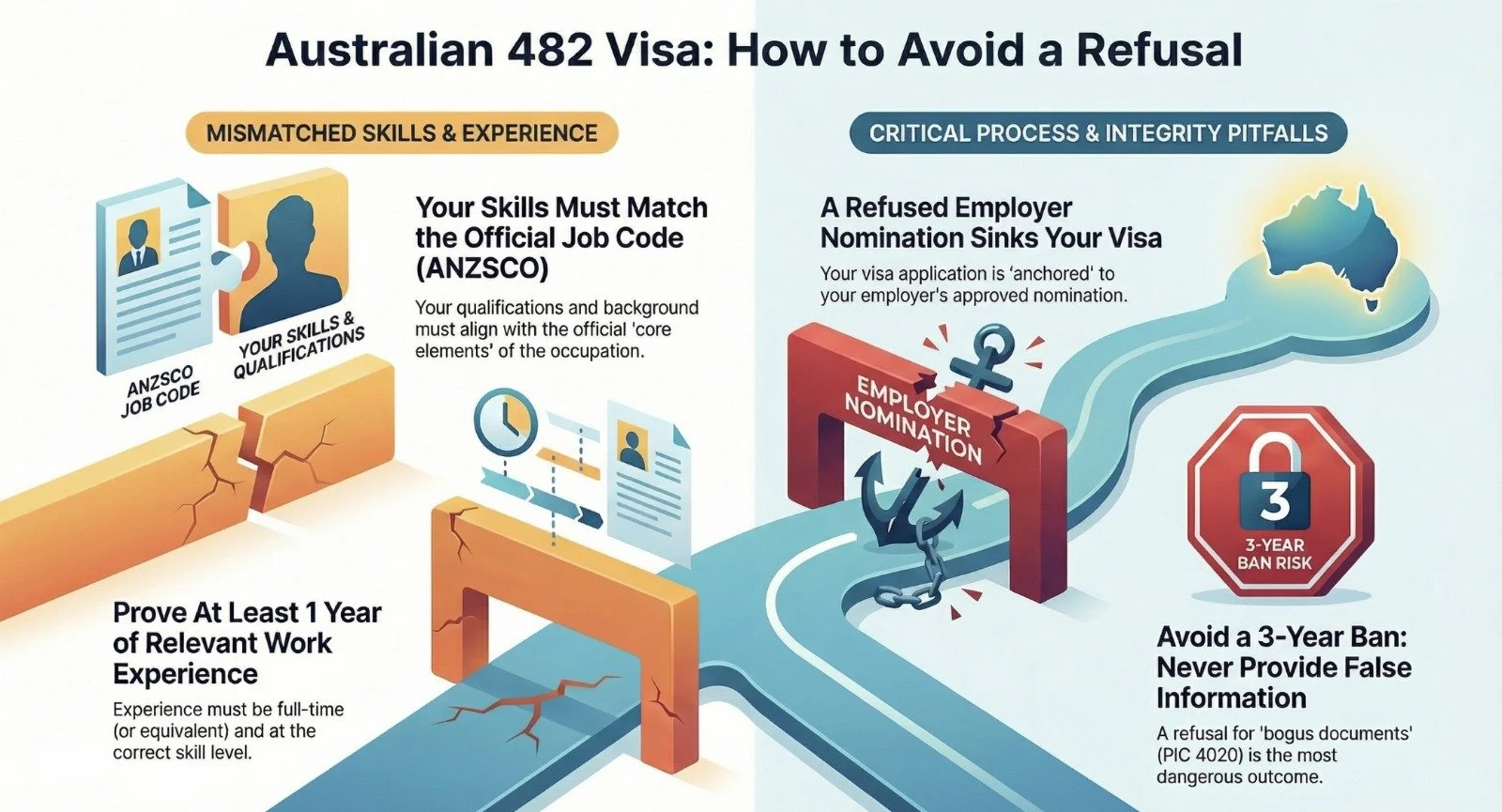
Applying for a Subclass 482 (Skills in Demand) visa is a significant milestone, but the process is rigorous. The Department of Home Affairs uses specific "Procedural Instructions" to decide whether to grant or refuse your application.
Understanding the common pitfalls can help you ensure your application is "decision-ready" and avoid the heartbreak of a refusal.
1. The "Anchor" Problem: Nomination Refusal
The SID visa is a three-stage process: Sponsorship, Nomination, and Visa Application. Your visa is "anchored" to your employer’s nomination.
The Risk: If your employer’s nomination is refused, withdrawn, or has ceased, your visa application generally cannot be approved.
How to Avoid It: Ensure your employer has a valid Standard Business Sponsorship and that their nomination application is technically sound before you lodge your visa. If the nomination is refused while your visa is pending, you should be given an opportunity to comment or withdraw to avoid a formal refusal on your record.
2. Inadequate Work Experience (The 1-Year Rule)
A major requirement for the Specialist and Core Skills streams is having at least one year of full-time work experience (or equivalent part-time) in your nominated occupation or a related field within the last five years.
The Risk: DMs will refuse applications where the work experience is deemed too low-level (e.g., counting "Cook" experience for a "Chef" position) or if the experience was gained through unpaid/voluntary work.
How to Avoid It: * Provide detailed employment references.
Ensure tasks performed in "related fields" match the ANZSCO skill level of your nominated role.
Pro Tip: If you are a medical researcher or certain performing artist, your study-based placements might count, so document them thoroughly.
3. ANZSCO Mismatch (Skills and Qualifications)
The Department uses the ANZSCO (Australian and New Zealand Standard Classification of Occupations) to determine if you have the right "kit" for the job.
The Risk: If you are nominated as an "Architect" but your degree is in "Law," or if your qualifications don't meet the "Indicative Skill Level" for your specific ANZSCO code, the DM will likely refuse the visa.
How to Avoid It: Check the ABS ANZSCO descriptions before applying. Your qualifications and background must align with the "core elements" of the occupation. If you don't have the exact degree, you must prove your years of experience are a valid substitute under ANZSCO guidelines.
4. Failing the "Genuine Intention" Test
A Decision Maker must be satisfied that your intention to work in the role is genuine and that the position wasn't created just to secure a visa.
The Risk: Applications are often flagged if the applicant’s background is vastly different from the role (e.g., a candidate with no management experience being hired for a "Specialist Manager" role).
How to Avoid It: Provide a comprehensive CV and evidence of your previous career path. If the career jump seems large, include a cover letter explaining how your transferable skills apply to the new role.
5. Health Insurance and Integrity (PIC 4020)
Small administrative oversights can lead to big problems.
Health Insurance: Under Condition 8501, you must have "adequate arrangements" for health insurance. Simply saying you will get it isn't enough; you must declare you have made arrangements for the duration of your stay.
The Integrity PIC (4020): This is the most dangerous refusal. If the Department finds you provided "false or misleading information" or "bogus documents," you could face a three-year ban on further visa grants.
📩 Contact us today!
📞 +61 439184999 📧 ask@visamigo.com.au
🌐 www.visamigo.com.au
Disclaimer: Important notice for all our social media followers and website readers. Content shared here by Visamigo Lawyers and its affiliates is not to be considered as immigration or legal advice. It is intended for informational purposes only and should not be used as a substitute for professional guidance. This material offers general insights (accurate at the time of posting, subject to updates) and is not exhaustive. Prior to any application, it is recommended you consult an Australian Lawyer for personalised advice. Your journey matters, so ensure you're properly informed.